Monday, June 12, 2023

Wanna Bet?


    Las Vegas...Sin City...is recognized as the gambling capital of the world. That's kind of fitting when you see the city's hockey team about to win the Stanley Cup at a time when a total bombardment of betting ads during games is annoying the heck out of real NHL fans.
    A few weeks ago, Karl Subban, school principal, author and father of three pro hockey players, publicly called for a ban on betting ads shown during NHL games. He's become a voice for the national advocacy group, "Ban Ads for Gambling."
    "They catch the attention of young people," Subban said. "It's a powerful way of marketing to them, which we know can have a harmful effect on young people realizing their potential and really reaching their dreams. So we need to have conversations about some of the things that are getting in the way. Either act today or pay dearly tomorrow."
    The problem is, many sports fans...many of them young...are already paying dearly.
    "The heavy promotion (of ads) means that a lot of more people are betting on sports now," says Nigel Turner, a researcher at the Canadian Centre for Addiction and Mental Health. "It used to be a fairly small percentage of the total clinical mix of problem gambling. In the past year, online gambling has gone from being a pretty minor percentage of the people who call in the helpline to being the number one reason that people are calling the helpline prior to like 2-3 years ago."
    "We are creating a generation of people who are thinking of gambling as a safe activity and there are people who are looking up to the celebrities promoting gambling as a as a way of making money. But it's not a way of making money, it's a way of entertaining yourself losing money," Turner says.

                       Nigel Turner: Canadian Centre of Addiction and Mental Health

    Turner and his colleagues see a direct correlation between the number of people who need help escaping from online gambling and the proliferation of sports betting commercials.
    "It's too soon to tell whether this is going to exceed prior problem levels of gambling. I am monitoring the situation," he says. "There's usually a lag between when when gambling becomes available and when people show up in treatment, partly because most people don't actually seek treatment and they try to solve their problem on their own. They go bankrupt on their own. So there's there's usually a lag. But we have seen a spike in calls related to online gambling sooner than we expected."
    As Turner points out, by the time people look for help it's often too late and they're already in a serious financial hole. His team is particularly concerned about the celebrity endorsers...Wayne Gretzky, Auston Matthews and Connor McDavid among them...who are actually influencing the brain development of young fans.


    "Well, young people are considered to be particularly vulnerable to gambling and and addictions in general because part of being an adolescent is being more impulsive and, particularly focusing on males, they are more impulsive by nature, and gambling appeals to the impulsive nature of youth," Turner explains. 
    "And when you establish a gambling problem your brain gets kind of hooked into a sequence of expectations. So if somebody who's young starts gambling too much, they are changing the way their brain functions and their brain activity is telling them to keep gambling. And that's a concern to us that we're creating a generation of people who are going to be gambling more."
    Turner and Subban aren't alone in expressing their concern for the health of young people who may be most vulnerable to gambling ads. This week, the chief of the Mississaugas of Scugog Island First Nation, Kelly LaRocca, published an open letter to Gretzky, McDavid and Matthews, asking them to stop promoting gambling. She says she sees a direct link to the ads and the interest of kids in betting.
    "I hope that they stand down from advertising iGaming," LaRocca said. "Our youth look up to them. They're being told that it's okay to just pick up and gamble whenever you feel like it."
    The Alcohol and Gaming Commission of Ontario, which regulates gambling in the province, is now contemplating a ban on "the use of athletes as well as celebrities that can reasonably be expected to appeal to children and youth from internet gambling, advertising and marketing." It may be "contemplating" a ban, but there isn't one so far. And nobody's talking about stopping the ads...just stopping the celebrity promotion.
     For adult fans, the betting ads are annoying. For people with addictions, they're tempting. And for adolescents, they're dangerous, according to the experts.


    However in a league devoted to finding new sources of revenue, those gambling ads are worth a lot of money. They're inserted into the games themselves, feature in intermission analysis segments and are plastered all over the boards and the ice. The risk to vulnerable youth doesn't seem to trump the league's desire to squeeze out every dollar possible, regardless of the source.
    It's fitting, then, that the team from the Gambling Capital of the World, which was handed a sweetheart expansion draft that made it able to compete immediately, is poised to take home the hardware. If the league wants to make money, its expansion teams need to win right away in order to keep the new fans' cash flowing. Commissioner Gary Bettman has created the perfect circumstances for that to happen.
    In the meantime, the Vegas Golden Knights have become the poster child for the new, high-stakes NHL. They'll probably be Stanley Cup Champions five years into their existence. Young hockey fans will watch...ads and all...and soak up the message that NHL hockey is more than just sport. It's a get-rich-quick scheme. You can bet on it.

Monday, May 29, 2023

Parity Charity


    So, you're a team in a rebuild. Your Stanley Cup window is closed, your prospect pool is thin and you're vying for a lottery pick in the draft. There's a lot of work to do, and the experts say building from within, with in-house-developed youth on cap-friendly contracts, is the way to fix your team.
    But what if there's another way?
    What if the worst team in the NHL's regular season could opt to draft first overall OR trade in the bulk of its roster and do an expansion draft?
    GMs say drafting and developing players is the way to go...yet the five-year-old Vegas Golden Knights are about to win their sixth playoff round and make their first appearance in the Cup Final. The two-year-old Seattle Kraken have won as many playoff series as the Original Six Toronto Maple Leafs have in the last twenty years.
    If you think about it, it makes sense. Building a team through the draft involves years of choosing good junior players and hoping they develop into good pros. That process may also include a string of losing seasons, management shakeups, coaching changes and prospects who turn out to be busts.  It involves careful salary cap management and contract juggling. An expansion draft, on the other hand, features established players other teams have already developed and who have played in the NHL already, so the wait-and-see-how-they-turn-out aspect of team building is eliminated.
    Within the rules of the expansion draft there's an exclusive window for a team to speak with pending free agents before anybody else does. That would be helpful in attracting a star player or two to build a new roster, especially when your salary cap is wide open.
    Existing NHL teams can only protect eight skaters and one goalie, or seven forwards, three defencemen and a goalie in an expansion draft. The rules say of the players exposed, each team must make available one defenceman and two forwards who are under contract for the coming season and have played at least 40 NHL games. They must also expose a goalie who's under contract or will be an RFA at the end of his deal. That leaves a huge number of decent-to-good players available for the plucking. If you have a solid front office in place, management has the potential to build a competitive team right away. There'd be no worries about a high draft pick not panning out, or figuring out how to fit a star player into a tight cap situation or hoping your amateur scouting staff knows what they're doing. 
    It wouldn't be cheap, though. The other teams in the league would have an opportunity to claim any unprotected players from your roster, with a similar priority given to lower-ranking teams as claiming players on waivers. Any players left unclaimed would have to have their contracts paid out in full and become free agents. If you have a bunch of players with no-movement or no-trade clauses, you'd be stuck with them. They'd have to be your protected players, so it would encourage GMs to avoid those clauses.
    In the end, it'd be like poker. You keep the good card and throw in the duds for a new hand. You may end up with a pair of threes, but you could also score a royal flush. 
    One thing's for sure: building through the draft may or may not get you to the promised land after years of trial and error. Evidence seems to show an expansion draft gives you a whole lot better chance at winning in a much shorter time frame. While Gary Bettman gifts rich expansion team owners with the most favourable team-building option possible, it's only fair established teams should have a chance to follow suit.
    With that opportunity available, now you're a team in a rebuild looking at a chance to kick-start the process and bring your fans a show worth watching in a much shorter time frame. Sounds pretty good, doesn't it?

Thursday, May 18, 2023

Money and Morality


The NHL has a bear problem. 
    No, it's not the Big, Bad, Greatest-of-all-Time Bruins getting bounced in the first round of the playoffs. It's the bigger, badder, more problematic Russian bear and, as the league is unlikely to ban players from a specific country just because it's involved in an illegal invasion of its neighbour, each NHL team will have to decide: What do we do about the Russians?
    It's not an easy question to answer. Naturally, not every Russian or Belarussian hockey player is going to be pro-war, homophobic, contemptuous of the West that pays his big salary or a Vladimir Putin ally. Yet, Alex Ovechkin, the greatest Russian player of all time, proudly displays a photo of himself with Putin on his social media. All-Star Evgeni Malkin is on the record supporting Putin's policies and claiming Russia must defend itself because it has no friends in the West. Russian players, including the Habs' Denis Gurianov, refused to wear Pride Night jerseys this year, in part they said because of concern about reprisals for family members back in Russia where anti-gay laws are in force.
    The truth is, Russia is very different from other countries whose citizens make up the majority of NHL players. It's an authoritarian regime involved in a cruel genocide in Ukraine. Enemies of the state fall from balconies or are poisoned abroad. It's a place that dresses its school children in quasi-military uniforms and teaches them it's an honour to die for the Fatherland. It's a country run by a megalomaniac and his favoured oligarchs who feed their people lies about the West's evil intentions toward Russia, while living large in European mansions and luxury yachts themselves. In an environment ripe for breeding blackmail, embezzlement and physical threats.
    It's also a country that produces some of the best hockey players in the world. Thus, the aforementioned bear problem.

🏒🏒🏒🏒🏒🏒🏒🏒🏒🏒🏒🏒🏒🏒🏒🏒🏒🏒🏒🏒🏒🏒🏒🏒
   
    An NHL team's first priority is to win hockey games and satisfy the fans who pay good money to see those wins.
    So, when the draft comes around, a team obviously wants to take the best player possible. But, what if the best player available is a Russian with a KHL contract?
    That's the situation the Canadiens may find themselves in next month. Choosing at number five overall, there's a decent chance Russian winger Matvei Michkov will be available. The kid's talent is undeniable, and he could be a valuable part of a future championship team. His nationality, however, raises a lot of questions. Will he break his KHL contract early, or will his draft team have to wait three years to get him? Will he come to North America at all, if the KHL decides to woo him with big money and privileges? Will he end up drafted to fight in Russia's war? If he does come over, will he be free or will he be susceptible to threats or bribes from forces back home? What impact has a childhood of Russian state propaganda had on the formation of his character? And perhaps the most important question of all: Is it morally right to make deals with Russians while their country is committing war crimes?
    Other sports, including the Olympics (sort of), have disqualified Russian athletes because of their nation's actions. Hockey, though, has been willing to overlook all that as long as the player in question can help a team win and keep the gate turning over. The same is true of North Americans who sign contracts to play in the KHL. They're willing to work for warmongers as long as the money's good.
    The problem with that is, by ignoring the political and social reality of what's happening in Russia hockey is giving tacit approval to the country's war and corruption. Just look at the betting craze happening in the NHL right now. How much of a reach is it to imagine Russian interests who stand to make a bunch of money on gambling pressuring Russian players to fall in line?

🏒🏒🏒🏒🏒🏒🏒🏒🏒🏒🏒🏒🏒🏒🏒🏒🏒🏒🏒🏒🏒🏒🏒🏒
   

    The big question is, of course, whether there's room for scruples in a cut-throat pro sports environment. If one team decides there is and operates accordingly, it's easy enough for another team without the same standards to hire a problematic, but talented, player and get a leg up on the opposition. Having standards can limit the options a GM has when filling out his lineup. But having standards can also go a long way in re-establishing a team's reputation for being classy, which is a draw in itself.
    In the end, some team will absolutely pick Michkov in one of the top spots in this year's draft. Whether it's the Canadiens will say a lot about management's willingness to overlook moral objections in favour of winning hockey games. They made that choice in drafting Logan Mailloux and immediately were castigated for picking a guy who'd committed a criminal act. 
    So, Jeff Gorton and Kent Hughes will have a lot more than the usual soul searching to do this draft day. And their choice will tell us a lot about how far they're willing to go to win.

Monday, April 17, 2023

The Parity Prize


    Now that the NHL season is over, huge congratulations are due to the Boston Bruins. The Habs' nemesis set a league record with a total of 135 points, including 65 wins, 12 losses and 5 shootout loser points. It's an impressive showing, without a doubt. 
    The team to previously hold the record, at 132 points, with 60 wins, eight losses and 12 ties, was the 1976-77 edition of the Montreal Canadiens.
    Because of the Bruins' feat this year, there's a lot of chatter about whether that points total makes them the greatest NHL team of all time. Some will say it does. Others will believe the Bruins are the greatest parity team of all time. Bettman's Beauties, if you will.
    If you look at the Canadiens' '76-'77 roster, you'll find nine players and the coach were inducted into the Hockey Hall of Fame. They lost only eight games all year, and played no overtime. In the playoffs, they lost only two games (one in OT) on their way to winning the second of their four straight Stanley Cups.
    We don't know yet which Bruins, aside from Patrice Bergeron, could be Hall of Famers, but we can probably guess there won't be nine of them. We don't know if Boston will breeze to the Cup they way they breezed through the regular season.
    What we do know, however, is the regular season points totals can't be compared fairly.
    For one thing, the Bruins had the advantages of two extra games played. For another, they played 16 overtime games and seven more went to shootouts. The Canadiens didn't have that chance to accumulate points because OT wasn't introduced in the regular season until 1983. This year the Bruins went 11-5 in OT and 4-3 in the shootout. That means they claimed 8 points in games they lost. If they played with the same rules as the '76 Habs, you'd have to subtract those eight points. You'd also have to remove half of the 22 points they gained for winning in OT, where the Habs would have had to settle for one point in a tie. With those considerations taken, Boston would have had a respectable, but hardly world-breaking, 116 points. If you add the five loser points from the shootout and count them as points they'd have gotten in a tie, they get up to 121. A very good season, but not the greatest team ever.
    The Bruins not only had four extra points available on the schedule...they had the advantage of 3-on-3 overtime as well. One has to wonder how many of the twelve ties the '76 Habs recorded would have been wins after Scotty Bowman sent out Guy Lafleur, Larry Robinson and Steve Shutt in OT. Or how many more points they'd have recorded if they could have sent Lafleur and Jacques Lemaire out for the shootout.
   
    No, the days of dynasty, hall-of-fame lineups are largely behind us now. In a salary-cap league that rewards abysmal play with high draft picks, Gary Bettman's NHL is all about keeping the league as even as possible. In the '70s, there were two or three teams you could expect to compete for the Cup, with Montreal at the top of the heap. These days, any playoff team could legitimately make a Cup run, and any team (aside from the absolute bottom-feeder rebuilders and the Coyotes) can make the playoffs.
    The Bruins are a solid, cohesive team with very few holes. They're also not exciting or unique. The Bettman NHL doesn't want guys racing down the wing with their hair flying in the breeze, being original. It wants steady, respectable teams like the Bruins. All year, Boston played the same game on a Tuesday in February that they played on a Saturday night in April. Their consistency served them well in a tight league.
    But accumulating points in a 3-on-3 OT, shootout league with 82 game seasons and a draft lottery doesn't make a team the best ever. It doesn't even make them particularly special. They're simply very good at being predictably consistent.
    The Bruins are calling this year "a season to remember." They'll likely look back on it fondly, but will anyone else remember? Or care? That's what legends are all about, and this year's Bruins team has yet to stand the test of history.
        

Saturday, March 25, 2023

Pride


     This has been a very strange month in the NHL. Several teams scheduled Pride Nights to show their desire for every person to feel included in the game of hockey, no matter their sexual orientation. The point is to make a marginalized community which has faced exclusion, ridicule and scorn feel that the rink is a safe place for them. 
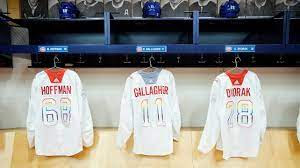
    Teams have held these nights for the last several seasons and the vast majority of players have been open to wearing rainbow-themed jerseys in warmup for one game, which are then auctioned off to benefit LGBTQ charities. Overall, Pride Nights have been great for outreach.
    Until now.
    Amidst a growing political divide in the USA between evangelical Christians and everybody else, several NHL players have decided wearing a rainbow jersey for fifteen minutes before one single game offends their religious beliefs to the point of making their refusal to participate the thing everyone's talking about.
                                                              

    Two years ago, when the Canadiens held their Pride Night, Erik Staal skated out with the rest of his teammates, wearing a powder-blue sweater with a beautiful rainbow CH on the front. This year, when the Florida Panthers announced their own Pride Night, Staal and his brother Marc decided it's no longer religiously acceptable for them to do that.
    For those who have applauded the efforts teams are making to be inclusive and welcoming, the Staals' and James Reimer's decisions to opt out have been disheartening.
    Or it is until you ask Kurt Weaver about it.
    Kurt's the COO of the You Can Play Project; the non-profit founded by the Brian Burke family to honour their son Brendan, who died in a car crash at age 21, and who happened to be a gay hockey player. The organization's purpose is to advocate for LGBTQ people's place in hockey. So, asking Weaver to weigh in on what's happening in the NHL could have provoked disappointment or anger. Instead, he said:
    "We're very excited that the NHL teams have taken all the steps they've taken around Pride Nights, pride engagement and the jerseys being worn at those things. And of course, the jersey is the most visible thing.
    "And it's definitely disappointing when an individual decides not to participate or maybe when a team decides to not have the jersey that year, but certainly, we are very proud of the progress and the success where we can be talking about one individual not wearing a pride jersey when just a few years back, one individual wearing a rainbow would have been a huge news story. So, the progress we've made cannot be denied at this front. And hopefully, it won't be seen as a failure or a misstep, it's something we're going to overcome and keep focusing on the positive of all the great work being done at these Pride Nights."
    Weaver makes it clear pride jerseys aren't meant to be offensive for those who claim religion as the reason for rejecting them.
    "Not at all. We like to say respect and religion are not mutually exclusive. Religion, to me, is a place that's welcoming, open and caring. Others may have a different perspective around that. But certainly religion is not something we like to hear as a reason for not doing something," he explains. "Much like other celebration nights, like military, you're not necessarily endorsing what those organizations are doing. You're saying you care about the people in them. We want to make a safe and inclusive place where people are welcome in hockey, and that's the message we believe those Pride Nights and those jerseys are sending."


    He thinks there's more to the players' decisions to reject Pride Nights than simply adherence to religious rules that didn't come into play two years ago.
    "It shows you where, politically, where we are now. If we were in a different place politically, it might be the military or the Indigenous jersey that was getting attacked," he said. "But right now, the LGBTQ community is in the spotlight and in the crosshairs of people who are trying to take stuff back. Especially in the US, versus Canada, you see some of those issues happening at the state level in legislation."
    And, he says, sometimes the players aren't making those decisions on their own.
    "These players have a lot going on. They're not PR specialists. They're not thinking this through. In many cases, we find there's individuals out there who are trying to find players who'll take a step back to make a news story. This is not an invention of a player who wants to do something. They're being approached by an organization that wants to make political hay out of this."
    Still, he says, when a player does decide to make a stand like Reimer and the Staals have done, his group makes the effort to meet with them and explain the reasoning behind Pride.
    "We reach out every single time," he said. "And each time we get to sit down with a player, we say, listen, this is how this affects the community. The fact that your jersey doesn't get auctioned off means funds don't go to a local mental health drop in facility that needs them, that helps kids. There's a knock-on effect to these things that maybe the players don't consider. And when given that information, almost every time, they realize what is a different way to look at things and come out, I would hope, with a better decision next time."
    Whatever individual players decide to do, however, You Can Play is focused on the big picture and how far the movement has come.
    "When talking about the Panthers specifically, the whole front office, the whole arena full of fans, 18 of the 20 guys are there in full support of the community. All the cool things that happened in the intermissions and before and after the game, and the outreach and the money raised, that's the story. The two individuals who chose to make a different decision are simply not the story."
    When you look at it that way, the story is a pretty good one.


Saturday, January 14, 2023

Triple Low Five


    When the Canadiens first announced they'd be honouring P.K.Subban with a special night at the Bell Centre, many of us wondered, "Why?" After all, others who made bigger contributions and spent more time with the Habs (hello, Andrei Markov and Tomas Plekanec!) didn't receive such treatment.
    Subban was a controversial figure when he played in Montreal, often through no fault of his own. Rumours of strife in the dressing room, conflict with management and Subban seeing himself as bigger than the team swirled through parts of his tenure. Although his hurt at being traded later translated to a few salty comments, there's no doubt he was a huge fan favourite. Most of the younger generation had never seen anybody like him before. So, when Subban would take the puck end to end (losing it half the time), they stood and cheered for him. When he made bold predictions, they loved it and when he was traded, they were furious.
    Still, considering the fact the Canadiens franchise prides itself almost to the point of silliness on its storied past, it seemed a bit strange to honour a player who spent only six seasons with the team. It didn't really fit with the celebrations we've seen retiring Hall-of-Famers' sweaters or marking a thousand games with the club.
    However, in a sad sort of way, it makes sense. At some point, the whole torch thing, the banners and the retired numbers become meaningless for a fan base that's never seen a Stanley Cup parade. Sure, they're impressive and all, but when number 33 is the most recent raised to the rafters and the man who wore it left Montreal almost 30 years ago, they're not exactly a touchstone for people who never saw them play.
    The new management regime understands fans need heroes they know, and for an entire generation, Subban was as good as it got. To them, he embodied the excitement of Canadiens hockey. He was brash, flashy, outrageous sometimes and a lot of fun to watch. In an increasingly diverse sport, he was also a reflection of the fanbase to itself in a way many hockey fans hadn't experienced before his arrival. He wasn't the best Hab, by far, but he was the modern-day reasonable hand-drawn facsimile. 
    It was touching to watch Subban accept his accolades, and fun when Carey Price came out for one last triple low five with his old friend and teammate. In the grand scheme of things, perhaps honouring Subban was a bit of a stretch, but the fans in the arena that night loved it.
    For those of us who remember watching Brian Skrudland's goal nine seconds into overtime, a sweaty Guy Carbonneau hoisting his first Cup as captain or Jean Beliveau skating into the sunset carrying Lord Stanley, the triple low five is a cute gimmick between friends having some fun. For those under 40 (40!), it's an adored piece of team lore. And, sadly, it's the best they have.
    On his special night, Subban spoke stirringly to the current roster, exhorting them to honour the uniform and leave it all on the ice. If they can and do, perhaps the next player the team honours in retirement will be one who excites the fans and delivers the championship they need, if accolades and Habs lore in the future are to have much meaning at all.

Tuesday, December 13, 2022

A Clean Slate


    Hockey Canada has announced a slate of nine people, five women and four men, it's chosen from among hundreds of nominees to lead the organization out of the scandal in which it's been embroiled for months. The previous board stepped down, some reluctantly, in October, months after news they had paid to settle a sexual assault claim came to light.
     In May, TSN's Rick Westhead broke the story that Hockey Canada had settled with a young woman who claimed to have been assaulted by eight players, including members of the 2018 World Junior team. His work led to the revelation that the governing body actually had a fund available to cover other such claims. There were 21 settlements, totaling nearly eight million dollars, going back to 1989.
    In the wake of Westhead's story, sponsors abandoned Hockey Canada, government suspended its funding and member provincial organizations declined to send any further player fees to the national body. In the end, there was no choice but for the board to step down and new blood infused.
    Hockey Canada members will vote on Saturday on whether to accept the new executive board. If they choose to do so, the organization, presumably, will be granted a fresh start in public opinion.

                              🏒🏒🏒🏒🏒🏒🏒🏒🏒🏒

    While Hockey Canada was trying to do damage control amidst its sex scandal this past summer, the Canadiens were trying to figure out what to do with their 2021 first-round draft pick. By now we all know what happened with Logan Mailloux. He was intimate with a young woman in Sweden when he was 17, and shared a photo of their interaction with teammates, without her knowledge. That's illegal and he was convicted of breaking the law and fined.
    Mailloux' actions were immature, careless, entitled and even cruel. The victim asked for an apology, which she claims was offered half-heartedly, at first. Following the news of his offense coming to light back home, Mailloux, in his NHL draft year, seemed to finally realized the seriousness of his actions and asked pro teams not to draft him because he wasn't ready.


     “The NHL Draft should be one of the most exciting landmark moments of a player’s career, and given the circumstances I don’t feel I have demonstrated strong enough maturity or character to earn that privilege in the 2021 Draft,” he said in a statement.
    The Canadiens' Marc Bergevin and Trevor Timmins, of course, went there anyway after many other teams ruled out drafting Mailloux. That kicked off an embarrassing round of backpedaling and "separating the person from the hockey" comments. 
    "The Canadiens are aware of the situation and by no means minimize the severity of Logan's actions," the team announced. "Logan understands the impact of his actions. His recent public statement is a genuine acknowledgment of his poor behavior and the first step on his personal journey.
    "We are making a commitment to accompany Logan on his journey by providing him with the tools to mature and the necessary support to guide him in his development. We are also committed to raising awareness among our players about the repercussions of their actions on the lives of others."
    Now, going on two years later, Mailloux still sits in professional limbo. He remains in junior with the London Knights, where he's putting up good numbers in a league where he physically dominates most other, younger players. He's missed significant development time with a serious shoulder injury and an OHL suspension for his actions in Sweden. The Canadiens invited him to development camp at the beginning of this year, where he was unable to play because of the shoulder, but they signed him to a three-year contract in October anyway. 


    Still, Gary Bettman and Bill Daly say Mailloux is not eligible to play in the NHL or its AHL professional development league until he gets their approval. Which will be...when? Just a month ago, the commissioner confirmed Mailloux hasn't received their blessing yet. In light of the Hockey Canada scandal, one must wonder why the NHL maintains such a double standard.

                              🏒🏒🏒🏒🏒🏒🏒🏒🏒🏒

    Logan Mailloux isn't a sure-fire future NHLer. He's got skill and size, but he's missed a lot of development time between his suspension, injury and the pandemic. His crime in Sweden has deeply impacted his hockey life, and, one would hope, his personal maturity. 
    However, he's still a 19-year-old hopeful who's spent the last two years publicly living down one of the worst things he's likely ever done. He's been named and shamed, criticized and condemned, written off and written about. He has owned up to his wrongdoing and apologized. He's willingly undergone counselling and faced embarrassing media questions with candour. He's committed to finding a way to give back to victims of crimes like his (though we've yet to see what that will be). He will carry the stigma of his past stupidity forever.
    At the same time, the eight Hockey Canada players who allegedly assaulted that young woman in 2018...accused of forcing themselves on her sexually while she was drunk...remain anonymous. They didn't face a trial, either in the courts or in public opinion. Whoever they are, some or all of them may be playing in the NHL or AHL right now. Not one of them has been publicly sanctioned by Bettman and Daly, admitted their part in the alleged assault, apologized or vowed to do better.
    Hockey Canada, by settling with the victim in that case, with the knowledge of the NHL, effectively brushed a crime arguably more egregious than Mailloux's away in the hope nobody would find out. Those players got away with their actions unscathed, while Mailloux is still pilloried for his own.

                              🏒🏒🏒🏒🏒🏒🏒🏒🏒🏒

    Science has proven that at age 17, the brain's prefrontal cortex has not fully developed and doesn’t complete its growth until approximately early to mid 20s. Its job is to perform reasoning, planning, judgment, and impulse control. Without the fully developed prefrontal cortex, a teen might make poor decisions and lack the ability to discern whether a situation is safe or appropriate. Teens tend to experiment with risky behavior and don’t fully recognize the consequences of their choices.
    Which all goes to say, teenage boys will make stupid mistakes, like showing off their sexual conquests to their buddies. That's why they need to be taught right from wrong by adults who can lead them to making sensitive (and legal) decisions. That's also why the Criminal Code of Canada doesn't name minors who break the law.


    Yet, even though Hockey Canada has been paying off assault victims for decades, it only announced this past summer it would make training about sexual misconduct for junior players...what it is and its consequences for all involved...mandatory. The organization has known about this toxic and criminal behaviour for a very long time, but only public scandal forced its hand on taking action.
    This is the culture in which young male hockey players grow up. Good players, especially in small towns where they tend to be idolized, especially by young female fans, are gifted a level of permissiveness nobody else their age receives. Their talent is more important than their behaviour in a world where skill gets you to the next level and the coaches and parents who dream of a kid going pro enable actions that would, in anyone else, be appropriately punished.
    Hazing, underage partying and misguided ideas about sex are rife in junior hockey, but in the past have been let go by adults whose vicarious hopes and real-life jobs depend on these young players. How is a 17-year-old raised in that environment supposed to understand the seriousness of "jokingly" sharing a sex pic with his teammates?
    None of this is meant to excuse Logan Mailloux's behaviour of course. But Hockey Canada and the NHL created the circumstances that enable decisions like his and in the past have been complicit in these situations by hiding them with no consequences for the perpetrators. Singling out the kid who made a terrible choice and has paid for it is hypocritical and disingenuous to an astonishing degree.
    So, if the new Hockey Canada board wants to make a real difference, outside of cynically doing what it must to restore its prestige, it needs to start with players like Mailloux. If he's truly remorseful and wants to help, he can be an example for others in a positive way. His story can be educational and maybe inspire his peers to understand why they can't use their privilege to harm others. And Hockey Canada needs to take responsibility for the actions of the players who represent it by ceasing the secret payouts to victims and making the perpetrators own their behaviour publicly.
    As for Bettman, Daly and the NHL, if they're going to ban players for doing wrong, it must be all of them...not just the kid who's ended up living his shame in public. And if they're as shocked and dismayed by Mailloux's behaviour as they claim to be, they need to step up and fund training, oversight and clear definitions of appropriate behaviour...with clear consequences...for the next generations of kids who will pay their salaries.